


Innerspark.us – A professional artist resume must focus on a curated portfolio link, a concise exhibition history, and technical proficiency rather than listing every minor workshop or unrelated job. By prioritizing high-impact achievements over lengthy descriptions, you ensure gallery directors and creative leads immediately grasp your unique artistic voice and professional reliability.
The Core Philosophy of an Artist Resume
Unlike corporate resumes that rely on chronological job titles, an artist resume—often called a Curriculum Vitae (CV)—is a living document of your professional evolution. It is not a biography; it is a strategic summary of your creative contributions to the field. Your goal is to demonstrate that you are a serious practitioner who actively engages with the art community.
Many artists make the mistake of including every single group show they participated in during college. While early experience is valuable, professional galleries are more interested in recent, juried, or significant solo exhibitions. Quality always outweighs quantity in the competitive world of fine art.
Essential Components to Include
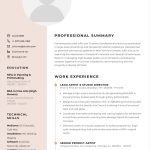
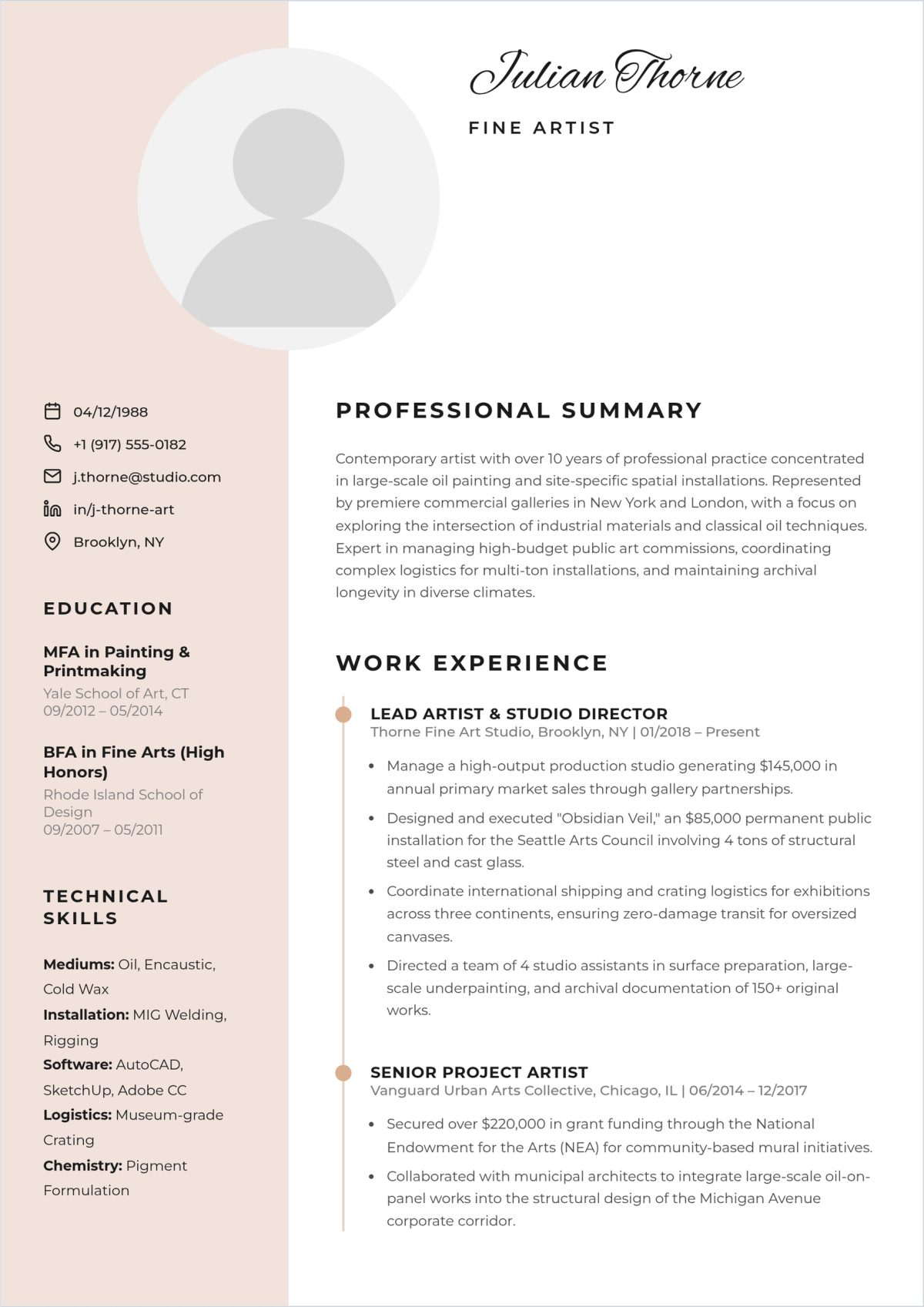
Your resume should be clean, readable, and formatted in a standard font. Start with your contact information, including your full name, phone number, email address, and a direct URL to your professional portfolio website. If you maintain an active presence on professional social media platforms where you showcase finished work, include those links as well.
Following your contact details, your Education section should be brief. List your degrees, the institutions, and the years of graduation. If you have received specific honors or residencies, these deserve their own dedicated sections, as they serve as social proof of your talent and dedication.
What to Cut Immediately
The “less is more” rule is vital. Remove any mention of high school achievements or unrelated part-time jobs, such as retail or administrative work, unless those roles specifically involved art handling, curation, or gallery management. Avoid writing long, flowery artist statements within the resume itself; save that for your separate artist statement document.
Furthermore, cut out generic skills. Listing “creativity” or “hardworking” is filler that wastes valuable space. Instead, focus on tangible technical skills such as specific printmaking techniques, digital software proficiency, or expertise in rare materials.
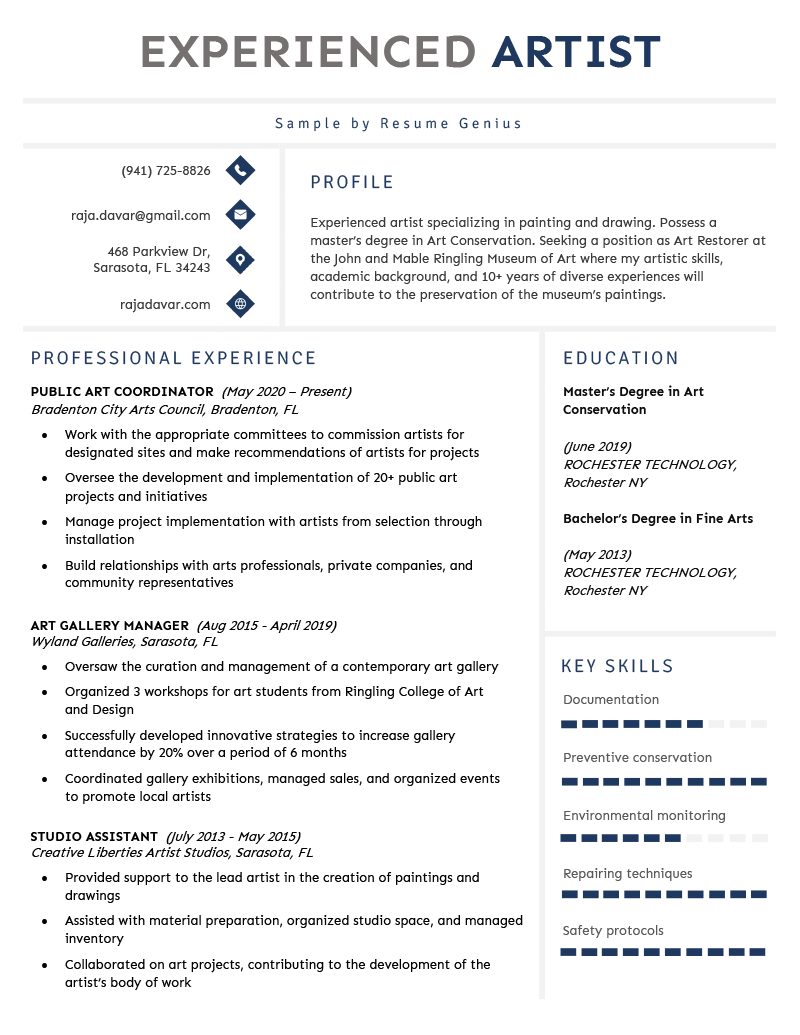
📷 Photo by resumegenius.com
Structuring Your Professional Data
Organizing your information effectively helps curators scan your document in seconds. Use the following table as a guide for what to prioritize and what to leave off your final draft.
| Category | Include (Keep) | Cut (Remove) |
|---|---|---|
| Exhibitions | Solo shows, juried group shows | Coffee shop displays, high school art fairs |
| Education | University degrees, relevant certifications | High school diploma, non-art related courses |
| Skills | Software, specialized tools, languages | Generic traits (e.g., “motivated,” “honest”) |
| Experience | Gallery work, residencies, teaching | Unrelated service industry roles |
Step-by-Step Guide to Crafting Your Resume
Follow these steps to ensure your resume is ready for professional submission:
- Select a clean, sans-serif font like Arial or Helvetica, and keep the design minimal to let your work speak for itself.
- Create a clear hierarchy of information, starting with your most recent professional activities and working backward.
- Standardize your formatting for dates and locations throughout the entire document to show attention to detail.
- Include a dedicated section for “Selected Collections” if your work is held in private or public institutions, as this adds significant credibility.
- Export your final document as a PDF, ensuring the file name is professional, such as “FirstName_LastName_CV.pdf.”
- Review the links to your portfolio to ensure they are clickable and lead to a fast-loading, up-to-date website.
Common Pitfalls to Avoid
One of the most common errors is failing to update the document regularly. An outdated resume suggests that your career has stalled. Aim to update your CV every time you participate in a new show or complete a residency. Another mistake is using overly complex graphics or background images that make the text difficult to read. Galleries receive hundreds of applications; if a curator has to struggle to read your contact info, they will likely move on to the next candidate.
Avoid using “objective” statements at the top. These are outdated and redundant. Instead, let your exhibition history and awards speak to your objectives. If you find your resume is becoming too long, prioritize your most recent five years of activity and condense older entries into a “Selected Exhibitions” section.
The Importance of Context
Remember that your resume acts as a companion to your portfolio. While your images show your technical skill and aesthetic, your resume shows your professional trajectory. A well-organized CV provides the narrative context of your career, showing curators that you are an artist who understands the professional standards of the industry.
“An artist’s resume is the bridge between their studio practice and the professional art market. It must be as meticulously curated as the exhibition itself.”
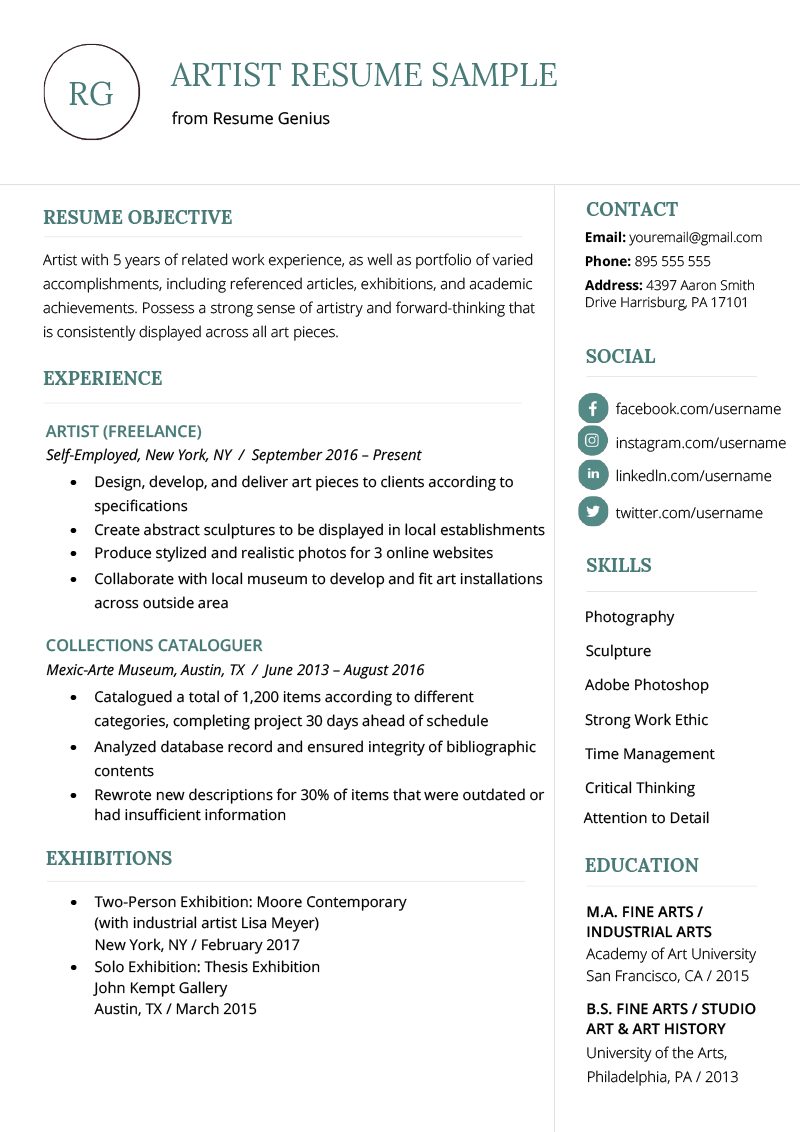
📷 Photo by resumegenius.com
Frequently Asked Questions
Q: Should I include my artist statement in the resume?
A: No. Keep your artist statement as a separate document. Your resume should focus strictly on your professional history and achievements.
Q: How far back should I list my exhibitions?
A: Generally, focus on the last 5 to 10 years. If you are an emerging artist, you can include earlier work, but categorize them under “Selected Exhibitions” to maintain a high standard.
Q: Is it okay to use a creative layout with colors?
A: Keep it professional. While you can use subtle color for headers, avoid busy backgrounds or complicated layouts that distract from the text. Readability is your highest priority.
📷 Photo by template.net